Sign In
Select Your Favourite
Category And Start Learning.
-

AI and Data Science Courses – Learn Analytics, Prediction, and Insight
Welcome to SmartNet Academy’s dynamic lineup of AI and data science courses—where future-ready skills meet hands-on learning. In today’s digital economy, the ability to extract meaning from data and drive decisions with intelligent systems is one of the most in-demand skills across industries. That’s why our curriculum is built to help you become more than just data-aware—it’s designed to help you become data-capable.
-

AI Courses for Career Development and Workplace Productivity
In today’s fast-changing job market, standing still means falling behind. Whether you're aiming to accelerate your current role or reinvent your professional path, SmartNet Academy’s curated learning experience puts you in control. Designed to support real transformation, our AI courses for career development help you gain confidence in navigating a future shaped by automation, intelligent tools, and strategic thinking. -

AI for Designers Courses – Learn Creative Tools, Automation, and Innovation
The future of design belongs to those who know how to use artificial intelligence to elevate their creativity—and that’s exactly what you’ll learn with SmartNet Academy’s AI for designers courses. Whether you're a freelance graphic designer, a digital artist, or a marketing creative, these lessons are built to help you unlock faster workflows, bolder ideas, and polished visuals using cutting-edge tools.
-

AI in Software Development and Cloud Computing
Explore how AI enhances software development and cloud computing. Learn to build intelligent apps, automate software delivery, and deploy scalable machine learning models on cloud platforms. Our courses provide practical tools and skills to optimize efficiency and performance in development and operations. -

AI Sales Courses for Modern Professionals – Automate, Optimize, Close Smarter
Welcome to SmartNet Academy’s top-tier destination for AI sales courses and digital marketing—where smart technology meets smarter selling. In today’s fast-paced business world, integrating AI into your sales and marketing strategy isn’t a luxury—it’s a necessity. These courses are crafted to equip professionals with practical, in-demand skills for a digital-first economy.
-

Artificial Intelligence and Emerging Technologies Hub
Welcome to SmartNet Academy’s AI and Technology Mastery hub, your ultimate destination for building essential skills in Artificial Intelligence (AI) and emerging technologies. Our courses are designed for learners of all levels, from beginners to professionals, and offer practical knowledge that can transform your career. -

Best AI Courses for Business Leaders
Welcome to SmartNet Academy’s category crafted specifically for forward-thinking professionals ready to lead with intelligence. These are the best AI courses for business leaders who recognize that artificial intelligence is more than a tech trend—it’s a powerful business strategy.
-

Best AI Courses for Finance Professionals
Welcome to SmartNet Academy, where innovation meets financial expertise. Our dedicated category of AI courses for finance professionals is designed to equip modern finance experts with the skills needed to thrive in a technology-driven landscape. Whether you're an experienced portfolio manager, a financial analyst exploring automation, or an accountant seeking efficiency, our courses offer the right balance of theory, tools, and real-world application.
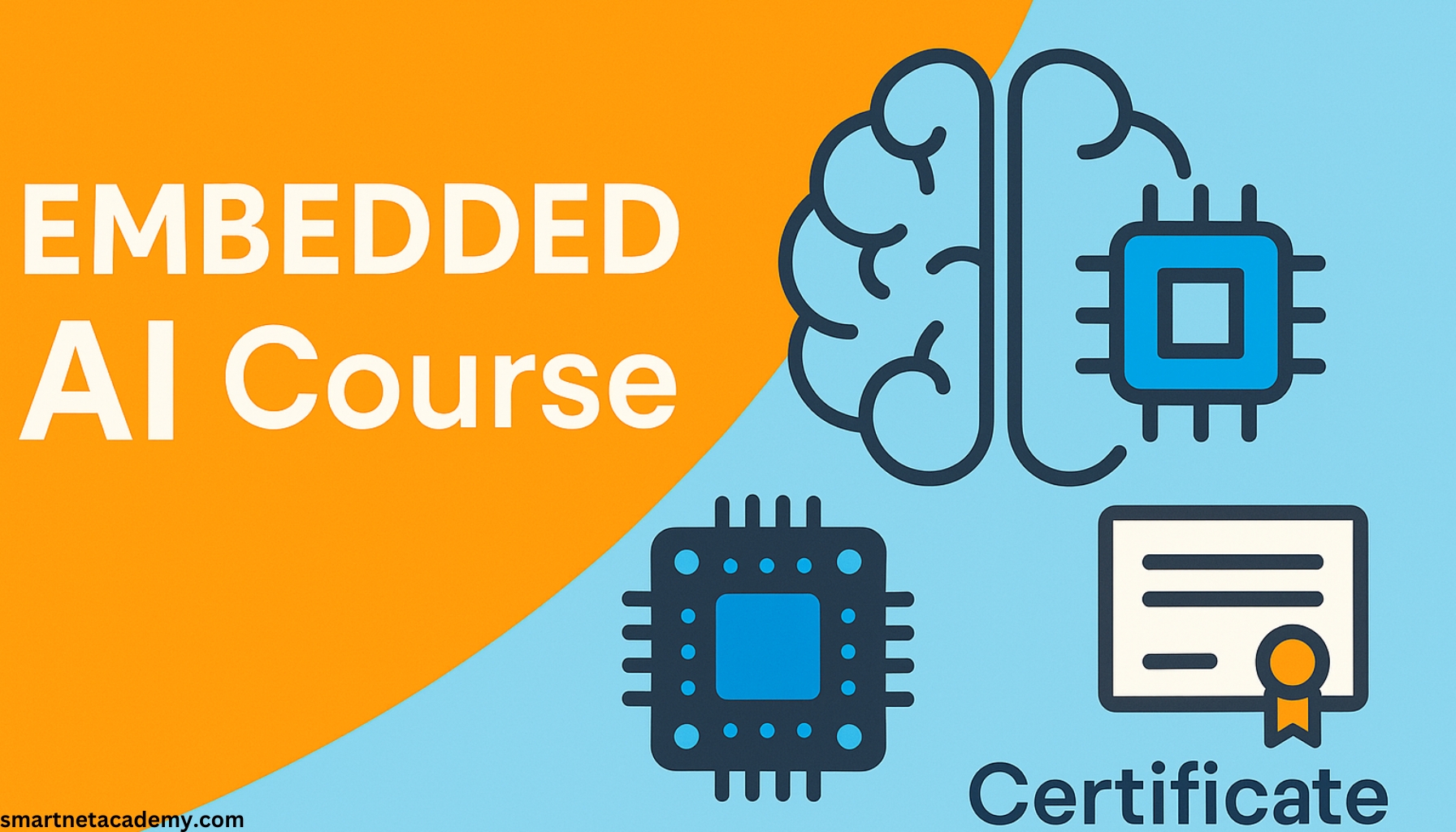
Embedded AI Course: Master AI Integration for Smart Devices and Real-Time Applications
Course Content
Introduction to Embedded AI and Smart Devices
-
Foundations of Embedded AI: Powering Intelligent Devices
00:00 -
Essential Components of Smart Devices and Their Role in Real-Time Intelligence
00:00 -
The Evolution of AI in Embedded Systems
00:00 -
Quiz: Basic Concepts of Embedded AI
Embedded Systems Architecture and Real-Time Processing
Designing AI Algorithms for Embedded Devices
Implementing and Optimizing Real-Time AI Applications
Future Trends and Innovations in Embedded AI
About Course
Welcome to the Embedded AI Course: Master AI Integration for Smart Devices and Real-Time Applications, an innovative course offered by SmartNet Academy! In this transformative course, you will embark on a journey to master the integration of artificial intelligence (AI) into embedded systems, enabling you to create smarter, more responsive devices. Whether you’re a software engineer, an electronics enthusiast, or someone eager to dive into the world of smart devices, this course will equip you with the practical skills and knowledge to excel in the rapidly growing field of embedded AI.
AI and embedded systems are rapidly merging, bringing intelligence and autonomy to everyday devices. This course provides a comprehensive framework starting with foundational concepts of embedded AI and advancing to real-time data processing, machine learning model deployment, and hardware-software co-design.
By the end of this course, you will understand how to design and implement AI models in resource-constrained environments, allowing you to build intelligent systems for applications such as IoT, wearables, home automation, and more. This hands-on course ensures you gain the knowledge and experience to transform smart ideas into practical, AI-powered devices.
Course Overview: What You’ll Learn in the Embedded AI Course
This course begins with an exploration of AI fundamentals and how they apply to embedded systems. As we move through the course, you will learn to deploy and optimize AI models for real-time performance, creating efficient systems capable of making intelligent decisions.
Introduction to Embedded AI
In this section of the course, you will begin with a comprehensive introduction to embedded AI, setting the foundation for understanding how artificial intelligence enhances the functionality of smart devices. Embedded AI involves integrating AI models directly into hardware, enabling devices to make intelligent decisions without the need for constant communication with cloud-based systems. This approach has become essential for the development of smart technologies such as wearables, IoT devices, and autonomous vehicles, where real-time performance is a crucial factor.
Understanding the Role of AI in Embedded Systems
Embedded systems are devices that are designed to perform specific tasks and are often constrained by limitations such as processing power, memory, and energy consumption. However, AI technologies—including machine learning, neural networks, and deep learning—allow these systems to perform more complex tasks, such as making predictions, detecting patterns, and adapting to changes in the environment. This is what makes embedded AI such a powerful tool for transforming everyday devices into intelligent systems capable of autonomous decision-making.
Machine Learning Models in Embedded AI
Machine learning models are central to the functioning of embedded AI systems. You will learn how these models are designed to operate within resource-constrained environments, meaning they need to be efficient in terms of processing speed and memory usage. In embedded AI systems, common machine learning techniques include:
-
Supervised Learning: Used for applications like facial recognition or speech recognition.
-
Unsupervised Learning: Helps detect patterns or anomalies without predefined labels.
-
Reinforcement Learning: Applied to decision-making processes, such as in autonomous navigation.
You’ll explore how these techniques are optimized for real-time decision-making in embedded devices.
Neural Networks and Deep Learning in Embedded Devices
Next, we delve into neural networks and deep learning models, which are the backbone of advanced embedded AI. These models mimic the human brain’s ability to process information, enabling devices to learn and adapt based on experience. By utilizing deep learning algorithms, embedded systems can process complex data inputs, such as images, voice commands, and sensor readings, without the need for external computing power.
In this section, you will explore how to design lightweight neural networks that are efficient enough to run on embedded hardware, using techniques such as quantization, pruning, and edge computing.
Real-Time Data Processing and Performance
Another core component of embedded AI is the ability to process data in real-time. You will learn about the various data processing techniques that enable embedded devices to make immediate decisions. These techniques are especially useful in applications such as autonomous driving, where millisecond decision-making is critical, or wearables that monitor health metrics in real-time.
The course will guide you on how to optimize real-time data processing by balancing the demands of speed, accuracy, and energy efficiency, ensuring that AI models can run seamlessly on devices like smartphones, fitness trackers, or IoT sensors.
Overcoming Challenges in Embedded AI
Working with embedded AI presents unique challenges, especially when dealing with devices that are limited by hardware capabilities. As a student of this course, you will learn how to:
-
Optimize AI models for low-power, low-latency applications.
-
Reduce memory usage without sacrificing performance.
-
Address hardware limitations by using AI models that are specifically designed to operate efficiently on embedded devices.
This section will provide you with the necessary knowledge to tackle these challenges and ensure that your AI systems are optimized for real-time performance and low power consumption, which is essential for smart device applications.
By the end of this section, you will have a solid foundation in embedded AI and its crucial role in enabling intelligent, real-time systems. You will understand how AI models, from basic machine learning algorithms to complex neural networks, are being used to create smarter, more responsive devices. This knowledge will set you up to further explore the advanced topics in the course, where you will gain hands-on experience in deploying and optimizing AI for embedded systems.
Machine Learning Models for Embedded Systems
In this section, we will dive deep into the types of machine learning models that are essential for creating intelligent embedded systems. These models are specifically designed to perform a variety of tasks, from predictions to real-time decision-making, within the limitations of embedded hardware. We will explore three fundamental types of machine learning models that are commonly used in embedded systems:
Supervised Learning for Prediction Tasks 📊
Supervised learning is one of the most widely used machine learning models in embedded systems. In supervised learning, the model is trained using labeled data, where the correct output is already known. This allows the model to learn from the data and make predictions or classifications based on the patterns it identifies. Supervised learning is ideal for tasks such as:
-
Speech recognition: For devices like voice assistants, where the system must recognize specific commands or words.
-
Image recognition: Used in devices like smart cameras or security systems to identify objects, faces, or activities.
-
Sensor data prediction: Applied in wearables that use data from temperature, pressure, or heart rate sensors to predict health metrics or events.
You will learn how to implement supervised learning models in resource-constrained environments, focusing on techniques such as feature extraction and model compression to ensure that these models work efficiently on embedded devices.
Unsupervised Learning for Pattern Recognition 🔍
Unsupervised learning differs from supervised learning because it uses unlabeled data, meaning that the model learns to identify patterns and relationships within the data without predefined labels. This type of machine learning is highly useful in applications where the desired outcome is not explicitly defined. In embedded systems, unsupervised learning is often used for:
-
Anomaly detection: For example, in industrial IoT devices where the system identifies unusual behavior in equipment, alerting users to potential issues like malfunctions or wear.
-
Clustering and segmentation: Used in smart cameras or autonomous vehicles to group objects or classify environments without prior knowledge.
-
Sensor fusion: Combining data from multiple sources (e.g., temperature, humidity, motion sensors) to create a more comprehensive understanding of the environment, crucial for smart home devices.
In this section, you will explore how unsupervised learning algorithms such as K-means clustering, principal component analysis (PCA), and autoencoders can be implemented on embedded systems to extract insights and detect patterns in real-time.
Reinforcement Learning for Sequential Decision-Making 🎮
Reinforcement learning (RL) is particularly powerful in embedded systems that require sequential decision-making, where the model learns through trial and error. RL is often used in situations where an agent (the embedded system) interacts with an environment, learns from the consequences of its actions, and adapts its behavior over time to achieve a goal. Key use cases in embedded systems include:
-
Robotics and autonomous vehicles: Devices like drones or robotic arms can use RL to make real-time decisions while navigating or performing tasks in dynamic environments.
-
Optimization problems: RL can optimize systems such as energy management in smart homes or battery life in wearable devices.
-
Game-playing: RL is used to teach devices or applications to make optimal decisions in games, simulations, or interactive environments, including interactive learning systems.
In this course, you’ll explore RL algorithms like Q-learning, Deep Q-Networks (DQN), and policy gradient methods, and learn how to implement these on embedded systems with minimal processing power and low memory usage.
Optimizing Machine Learning Models for Embedded Systems ⚙️
One of the most significant challenges in deploying machine learning models on embedded systems is optimizing them to function efficiently on devices with limited processing power, memory, and energy. In this section, we’ll focus on various techniques to ensure that your models run smoothly on low-power devices without compromising performance:
-
Model Compression: Learn how to reduce the size of machine learning models through techniques like quantization, pruning, and distillation, making them more suitable for embedded systems with limited storage.
-
Edge AI: Implement AI directly on devices using edge computing, where data is processed locally rather than being sent to a cloud server. This reduces latency and energy consumption, enabling real-time processing.
-
Accelerators: Explore how hardware accelerators, such as FPGAs (Field-Programmable Gate Arrays) and ASICs (Application-Specific Integrated Circuits), can be used to speed up computations and improve the performance of AI models on embedded devices.
You will learn how to optimize models for embedded platforms like Raspberry Pi, NVIDIA Jetson, and Arduino, which are commonly used in IoT, smart home devices, and wearable technology.
By the end of this section, you will have a deep understanding of how machine learning models work in embedded systems and how to implement them efficiently for real-time performance in low-power environments. With a solid foundation in supervised, unsupervised, and reinforcement learning, you’ll be ready to create intelligent devices that can make autonomous decisions based on data from sensors, images, audio, and other sources, all while adhering to the constraints of embedded systems.
AI Optimization for Real-Time Processing
Optimizing AI models for real-time processing is crucial in embedded systems, where devices must respond instantly while operating under strict constraints like low power consumption and limited memory. In this section, we will explore the advanced techniques used to optimize AI models so they can perform efficiently in these resource-constrained environments. These optimization methods ensure that AI applications can run smoothly on embedded devices such as smartphones, IoT devices, and wearable tech, providing instant responses and maximizing energy efficiency.
Quantization: Reducing Model Size and Enhancing Speed ⚡
Quantization is a powerful technique used to reduce the size of machine learning models by converting high-precision weights (usually 32-bit floating point) into lower-precision formats, such as 8-bit integers. This process not only shrinks the size of the model but also speeds up the inference time without significantly sacrificing accuracy. For embedded devices that are limited in storage and processing capacity, quantization is a game-changer, allowing models to fit within the device’s memory while still maintaining real-time functionality.
-
Benefit: Reduces the model size, enabling faster computations and more efficient use of memory on embedded systems.
-
Benefit: Minimizes energy consumption while maintaining model performance, crucial for battery-powered devices like wearables or drones.
In this course, you will learn how to apply quantization techniques to your AI models, ensuring they are small, fast, and efficient enough to be deployed on embedded devices.
Pruning: Removing Redundant Components for Efficiency ✂️
Pruning is another key method used to improve the performance of machine learning models. It involves removing neurons or connections from a neural network that contribute little or no useful information during inference. By simplifying the network in this way, pruning helps to reduce the overall complexity of the model and makes it more efficient. In embedded AI applications, this leads to faster processing and less resource consumption, both in terms of memory and computation power.
-
Benefit: Reduces the complexity of models, enabling faster real-time processing and reducing the load on embedded hardware.
-
Benefit: Helps save energy and computational resources, extending the lifespan of devices, especially those operating in real-time environments like autonomous vehicles or smart sensors.
You’ll learn to prune your AI models effectively to ensure they are lean and optimized for embedded systems, enabling efficient performance even on low-power devices.
Edge Computing: Real-Time Data Processing Locally 🌐
Edge computing is the practice of processing data locally on the device itself rather than sending it to a remote server or the cloud. This technique is vital for applications where real-time processing is essential and latency must be minimized. In the context of embedded AI, edge computing allows devices to make immediate decisions based on data generated by local sensors, cameras, or microphones, without waiting for cloud-based responses. This approach greatly enhances the responsiveness and autonomy of embedded devices, such as smart cameras, robotic systems, or wearables.
-
Benefit: Reduces the time lag associated with sending data to the cloud, providing instant analysis and feedback, especially important for autonomous systems like drones and smart factories.
-
Benefit: Minimizes data transfer, which in turn reduces network bandwidth usage and cloud storage costs, while ensuring data privacy by keeping sensitive information on the device.
In this course, you will learn how to incorporate edge computing into your embedded AI systems to perform real-time data processing, significantly improving response time and operational efficiency.
Balancing Real-Time Processing with Energy Efficiency 🔋
A primary concern in embedded AI systems is the trade-off between real-time performance and energy consumption. Many embedded systems, particularly battery-powered devices, need to maintain high performance without draining the battery. This section will guide you on how to strike the perfect balance between speed and power through efficient AI model optimization.
-
Benefit: Learn how to design AI systems that deliver instant responses while being energy-efficient, allowing devices to function for longer periods without frequent recharging.
-
Benefit: Use power-efficient techniques to extend the lifespan of devices, which is critical for applications like wearables or sensor networks that need to operate for long durations.
You will explore methods such as model quantization and pruning in conjunction with hardware acceleration to improve performance without draining resources, ensuring that your AI models can run for extended periods in real-time environments.
The Future of Optimized Embedded AI
Optimizing AI models for real-time processing and minimal power consumption is crucial for deploying successful embedded AI systems. Whether you are working with IoT devices, smart gadgets, or robotic systems, these techniques will allow you to deploy AI-driven solutions that provide fast, intelligent responses while respecting the constraints of embedded hardware.
By mastering optimization strategies such as quantization, pruning, and edge computing, you will gain the skills to implement AI applications on embedded systems that are fast, efficient, and energy-efficient—key factors for successful real-time decision-making in smart technology. Through this course, you will be empowered to build AI models that are both high-performing and sustainable, making a significant impact in industries that rely on embedded systems for automation and intelligent decision-making.
Sensor Integration and AI
The integration of sensors and actuators into AI-powered embedded systems is at the heart of many modern technologies, from smart home devices to wearable tech and industrial IoT systems. By combining sensors with AI, these systems can make intelligent, real-time decisions based on collected data, allowing them to adapt to dynamic environments and improve efficiency. This section will cover the essential concepts of sensor integration and its role in enabling smart systems powered by artificial intelligence.
Understanding Sensor and Actuator Integration 🌐
Sensors are devices that collect real-time data from the environment, such as temperature, humidity, motion, light, pressure, and sound. These sensors capture essential information that can then be processed by embedded AI models for analysis and decision-making. On the other hand, actuators take the processed data and initiate actions based on AI’s interpretation, such as adjusting the temperature, triggering a motor, or changing a light’s brightness.
-
Benefit: Sensors act as the eyes and ears of AI-powered systems, providing the necessary inputs for real-time decision-making and allowing devices to autonomously react to environmental changes.
-
Benefit: Actuators help to physically implement the decisions made by AI models, enabling automated control and intervention.
Data Collection from Sensors: A Critical Step in AI Decision-Making 📡
To build effective AI-powered systems, you first need to gather high-quality data from sensors. The data collected can range from environmental factors to user behavior and biometric measurements. For example, temperature sensors in a smart thermostat collect data about the room’s temperature and feed it to an AI model that adjusts the thermostat settings accordingly. Similarly, motion sensors in smart security systems detect movement and trigger alerts or start recording based on the AI model’s analysis of the situation.
-
Benefit: Learning to gather and process data accurately from sensors ensures that AI models have the necessary inputs for making informed, actionable decisions.
-
Benefit: The ability to work with real-time data gives AI systems the ability to predict and adapt to changes in the environment, enabling smarter, more efficient behavior.
In this section, you’ll learn how to connect and interact with various types of sensors using embedded systems, including communication protocols such as I2C, SPI, and UART. You’ll explore data acquisition techniques, sensor calibration, and data filtering methods to ensure the reliability of the data being used.
Integration of AI Models with Sensor Data 🤖
Once data is collected from sensors, the next step is to integrate it with AI models that can process, analyze, and make predictions or decisions based on that data. Machine learning algorithms, such as supervised learning for classification or regression, can be applied to sensor data to recognize patterns, make forecasts, or trigger specific actions.
-
Benefit: AI models help translate raw sensor data into actionable insights, enabling systems to automate decision-making in real time.
-
Benefit: The integration of AI models allows systems to learn from past data, improving their accuracy and response over time.
In this course, you will learn to train and fine-tune machine learning models with data from sensors to enable intelligent decision-making, predictive maintenance, fault detection, and pattern recognition. This integration empowers smart systems to improve processes such as energy optimization, security monitoring, and health monitoring.
IoT Devices, Wearables, and Smart Home Systems 🏡⌚
The Internet of Things (IoT) is rapidly growing, with smart devices becoming an integral part of homes, industries, and healthcare applications. These devices rely heavily on sensor integration to collect real-time data and AI models to interpret the data for smart decision-making. For example:
-
Wearables like smartwatches use sensors to collect heart rate, step count, and sleep data, which are then analyzed by AI to offer personalized health recommendations or notify users about potential health issues.
-
Smart home systems use sensors for temperature control, security monitoring, and automated lighting, while AI models ensure optimal efficiency and automation by adjusting settings based on user behavior and environmental changes.
-
Industrial IoT systems integrate multiple sensors, including vibration and temperature sensors, to monitor equipment health and predict potential failures before they happen, improving maintenance strategies.
In this section, you will learn how IoT devices, wearables, and smart home systems interact with sensors and AI models to deliver value-driven automation. You will also explore how these systems are connected through communication networks like Wi-Fi, Bluetooth, and Zigbee.
Applications and Use Cases of Sensor-Driven AI Systems 💡
Once you have understood how to integrate sensors with AI, we will dive into various use cases where sensor-driven AI systems are making a significant impact:
-
Smart Cities: Learn how AI-powered systems in smart cities use sensors for traffic management, environmental monitoring, and energy optimization, improving quality of life and sustainability.
-
Healthcare: Discover how sensors in wearables and medical devices, combined with AI, provide real-time health monitoring, detecting anomalies in vital signs to offer early diagnosis and treatment recommendations.
-
Industrial Automation: Explore how embedded systems with AI and sensor integration optimize manufacturing processes, enhance equipment maintenance, and reduce operational downtime.
Through these case studies, you will gain a deeper understanding of how AI models and sensor data are transforming industries, improving operational efficiency, and creating new opportunities for innovation.
The integration of sensors with AI is a cornerstone of smart device development, enabling real-time data analysis and intelligent decision-making. In this section, you’ve learned how to integrate sensors with AI models to create powerful embedded systems capable of automating processes, detecting patterns, and adapting to environmental changes. By mastering sensor integration and AI, you’ll be well-prepared to build intelligent systems that improve functionality and performance across a wide range of applications. Whether for healthcare, smart homes, or industrial automation, these skills will position you to be at the forefront of the growing embedded AI field.
Cutting-Edge Tools and Platforms for Embedded AI
In the rapidly evolving world of embedded AI, the ability to leverage the right tools and platforms is crucial for developing efficient, real-time systems. These tools enable the deployment and optimization of AI models on resource-constrained devices, making it possible to integrate intelligence into everyday products. This section will guide you through some of the most popular and cutting-edge tools and platforms used for embedded AI, helping you develop smart devices that can process data and make decisions in real-time.
TensorFlow Lite for Embedded Systems 🤖
TensorFlow Lite is an optimized version of Google’s popular machine learning framework, TensorFlow, specifically designed for embedded and mobile devices. It enables you to deploy machine learning models on resource-constrained devices, ensuring minimal memory usage and low power consumption, which is essential for embedded systems.
-
Benefit: TensorFlow Lite makes it possible to run machine learning models on devices like smartphones, IoT devices, and microcontrollers without needing cloud-based processing.
-
Benefit: With model optimization techniques like quantization and pruning, TensorFlow Lite reduces the size of AI models, ensuring they work efficiently within limited hardware constraints.
In this course, you’ll learn how to integrate TensorFlow Lite into your embedded systems to deploy real-time AI models, from simple classification tasks to more complex systems like object detection or speech recognition.
Edge AI Platforms for Local Data Processing 🌐
One of the key advantages of embedded AI is the ability to process data locally on devices, which reduces reliance on cloud computing and speeds up decision-making. Edge AI platforms allow for real-time data analysis directly on devices, ensuring low latency, increased privacy, and reduced bandwidth usage.
-
Benefit: By utilizing Edge AI platforms, such as Google Edge TPU or Microsoft Azure IoT Edge, businesses can process large datasets locally, enabling real-time decision-making without needing constant cloud connectivity.
-
Benefit: Localized processing also allows for faster responses, making embedded AI systems ideal for applications where speed is crucial, like autonomous vehicles, industrial machines, and smart appliances.
This section will cover the various Edge AI frameworks and how they can be integrated into your embedded AI projects, enabling you to leverage AI models on edge devices and improve processing efficiency.
NVIDIA Jetson: A Powerful Platform for AI on Embedded Devices 🖥️
The NVIDIA Jetson platform is one of the most powerful and widely used solutions for running AI models on embedded devices. Designed specifically for edge computing and AI-powered robotics, the Jetson platform offers high computational power in a compact, low-energy form factor, making it ideal for a wide range of applications.
-
Benefit: With Jetson, you can develop complex, AI-driven systems like autonomous robots, drones, and intelligent video surveillance systems, all while maintaining efficient performance.
-
Benefit: NVIDIA’s CUDA cores and specialized GPU acceleration make it possible to run deep learning models with enhanced processing speeds, perfect for handling data from sensors, cameras, and other real-time sources.
Through this course, you will learn how to use NVIDIA Jetson boards, such as the Jetson Nano and Jetson Xavier, to develop AI-powered embedded systems. These platforms offer rich features like camera integration, computer vision, and image processing, making them invaluable for building high-performance smart devices.
Raspberry Pi: Versatile and Affordable AI Integration 🏡
The Raspberry Pi is an affordable, versatile platform widely used in embedded AI development. It is an excellent entry point for prototyping and learning embedded AI concepts, providing easy integration with sensors, actuators, and AI tools.
-
Benefit: Raspberry Pi offers a low-cost solution to build prototypes and small-scale projects without compromising on processing power or versatility. It supports a variety of machine learning frameworks like TensorFlow Lite and PyTorch for edge AI applications.
-
Benefit: The GPIO pins on the Raspberry Pi allow for seamless integration with physical components such as sensors, motors, and displays, enabling a wide range of real-world applications from smart home systems to industrial automation.
In this section, you will explore how to use Raspberry Pi in your embedded AI projects to build prototypes, enhance IoT functionality, and create intelligent devices with real-time decision-making capabilities.
Implementing Embedded AI Solutions with Cutting-Edge Platforms
The combination of tools like TensorFlow Lite, Edge AI platforms, NVIDIA Jetson, and Raspberry Pi provides the foundation to implement AI-driven applications in embedded systems across industries. From predictive maintenance to robotics and smart healthcare devices, these tools empower developers to create highly efficient, real-time solutions.
-
Benefit: These platforms offer a complete AI ecosystem, enabling the development of scalable embedded AI systems that integrate with various hardware and sensors, enhancing the functionality of smart devices.
-
Benefit: By mastering these cutting-edge platforms, you will gain the ability to build embedded systems that are not only powerful but also optimized for real-time performance, low latency, and low power consumption.
In this section, you will explore hands-on applications of these platforms, working on real-world projects that give you the skills needed to deploy embedded AI systems in various domains. These skills will allow you to build the next generation of smart devices that are both intelligent and efficient.
The tools and platforms discussed in this section are fundamental to unlocking the potential of embedded AI. From edge computing solutions to powerful development boards like NVIDIA Jetson and Raspberry Pi, these platforms provide the infrastructure needed to create intelligent devices that can process data, make real-time decisions, and adapt to changing environments. Mastering these tools will place you at the forefront of embedded AI development, equipping you with the skills necessary to build innovative solutions across industries. Whether you’re interested in robotics, IoT, or smart devices, this course will prepare you to leverage the latest technologies for cutting-edge AI applications.
Hands-On Projects and Real-World Applications
Hands-on practice is essential for mastering any new technology, and this course provides ample opportunity for you to apply what you learn. Through practical projects and case studies, you’ll have the chance to:
-
Develop a smart thermostat that adjusts temperatures based on AI-driven predictions.
-
Build a wearable health monitor that tracks vital signs and uses AI for real-time health alerts.
-
Design an AI-powered drone that can navigate autonomously using sensors and machine learning.
These projects will prepare you to apply embedded AI techniques to real-world problems, ensuring that you gain practical experience in creating smart devices.
Ethical Considerations in Embedded AI
As with any emerging technology, ethical considerations are crucial when deploying AI-powered devices. This section discusses important topics like:
-
Data privacy concerns in IoT and wearable devices.
-
Security risks in embedded systems and how to mitigate them.
-
Transparency in AI decision-making, ensuring fairness and accountability.
You will understand how to approach AI development with ethical responsibility, especially when dealing with consumer data in healthcare, smart homes, and other industries.
Course Certificate from SmartNet Academy
Upon successfully completing the Embedded AI Course, you will be awarded a Certificate of Completion from SmartNet Academy. This certificate is a testament to your in-depth understanding of how artificial intelligence can be integrated into embedded systems, empowering you to create smart, real-time applications and intelligent devices. The completion of this course will showcase your expertise in leveraging cutting-edge AI tools and techniques for embedded systems, equipping you to thrive in the fast-evolving field of AI-powered technologies.
Enhance Your Professional Profile 🌟
This certificate serves as a powerful addition to your professional profile, strengthening your resume and LinkedIn profile. It demonstrates to potential employers, collaborators, or clients that you possess specialized knowledge in embedded AI, and are proficient in integrating machine learning models, real-time processing, and other advanced AI functionalities into embedded systems.
-
Benefit: Adding this certification to your resume shows employers that you have the skills and knowledge to build smart devices using AI technologies.
-
Benefit: This credential will position you as an expert in AI-powered smart devices and embedded systems, setting you apart in a highly competitive job market.
By completing the Embedded AI Course, you will not only gain the technical skills required to design and deploy intelligent devices but also showcase your commitment to advancing your career in the growing field of AI. This certification is recognized as a credible proof of expertise and highlights your proficiency in the latest technologies transforming industries worldwide.
A Gateway to Career Advancement 🚀
The Embedded AI Course is your gateway to advancing your career and becoming a leader in the field of AI-powered embedded systems. By mastering the integration of AI into embedded devices, you’ll be prepared to take on more leadership roles, development positions, or innovative projects in industries such as:
-
IoT (Internet of Things)
-
Smart Home Technology
-
Robotics
-
Healthcare and Medical Devices
-
Automotive Systems
-
Industrial Automation
With the expertise gained from this course, you’ll have the confidence to drive AI-driven solutions within organizations, create smarter systems, and make valuable contributions to the future of embedded AI technologies. Whether you’re enhancing the capabilities of consumer electronics or contributing to smart city development, this certificate will give you the tools and recognition to make an impactful difference.
Join SmartNet Academy and Lead the Future of Embedded AI
At SmartNet Academy, we pride ourselves on providing industry-relevant, practical, and hands-on courses designed to equip you with the knowledge and skills you need to excel. This course is an exciting opportunity to become part of the future of AI integration, transforming industries and creating intelligent systems that are shaping the world.
-
Course Benefits: Gain access to expert-led instruction, practical case studies, and real-world applications.
-
Certificate Impact: This certificate from SmartNet Academy can open doors to higher-paying roles, career shifts, and the opportunity to lead AI innovation in embedded systems.
By earning the Embedded AI Course certificate, you’ll gain the expertise to not only understand the intricacies of AI in embedded systems but to lead projects that drive business growth, efficiency, and innovation. Don’t miss this opportunity to solidify your position as a leader in the AI-powered smart devices space. Join us today and start your journey to mastering the future of embedded AI.