Sign In
Select Your Favourite
Category And Start Learning.
-

AI and Data Science Courses – Learn Analytics, Prediction, and Insight
Welcome to SmartNet Academy’s dynamic lineup of AI and data science courses—where future-ready skills meet hands-on learning. In today’s digital economy, the ability to extract meaning from data and drive decisions with intelligent systems is one of the most in-demand skills across industries. That’s why our curriculum is built to help you become more than just data-aware—it’s designed to help you become data-capable.
-

AI Courses for Career Development and Workplace Productivity
In today’s fast-changing job market, standing still means falling behind. Whether you're aiming to accelerate your current role or reinvent your professional path, SmartNet Academy’s curated learning experience puts you in control. Designed to support real transformation, our AI courses for career development help you gain confidence in navigating a future shaped by automation, intelligent tools, and strategic thinking. -

AI for Designers Courses – Learn Creative Tools, Automation, and Innovation
The future of design belongs to those who know how to use artificial intelligence to elevate their creativity—and that’s exactly what you’ll learn with SmartNet Academy’s AI for designers courses. Whether you're a freelance graphic designer, a digital artist, or a marketing creative, these lessons are built to help you unlock faster workflows, bolder ideas, and polished visuals using cutting-edge tools.
-

AI in Software Development and Cloud Computing
Explore how AI enhances software development and cloud computing. Learn to build intelligent apps, automate software delivery, and deploy scalable machine learning models on cloud platforms. Our courses provide practical tools and skills to optimize efficiency and performance in development and operations. -

AI Sales Courses for Modern Professionals – Automate, Optimize, Close Smarter
Welcome to SmartNet Academy’s top-tier destination for AI sales courses and digital marketing—where smart technology meets smarter selling. In today’s fast-paced business world, integrating AI into your sales and marketing strategy isn’t a luxury—it’s a necessity. These courses are crafted to equip professionals with practical, in-demand skills for a digital-first economy.
-

Artificial Intelligence and Emerging Technologies Hub
Welcome to SmartNet Academy’s AI and Technology Mastery hub, your ultimate destination for building essential skills in Artificial Intelligence (AI) and emerging technologies. Our courses are designed for learners of all levels, from beginners to professionals, and offer practical knowledge that can transform your career. -

Best AI Courses for Business Leaders
Welcome to SmartNet Academy’s category crafted specifically for forward-thinking professionals ready to lead with intelligence. These are the best AI courses for business leaders who recognize that artificial intelligence is more than a tech trend—it’s a powerful business strategy.
-

Best AI Courses for Finance Professionals
Welcome to SmartNet Academy, where innovation meets financial expertise. Our dedicated category of AI courses for finance professionals is designed to equip modern finance experts with the skills needed to thrive in a technology-driven landscape. Whether you're an experienced portfolio manager, a financial analyst exploring automation, or an accountant seeking efficiency, our courses offer the right balance of theory, tools, and real-world application.
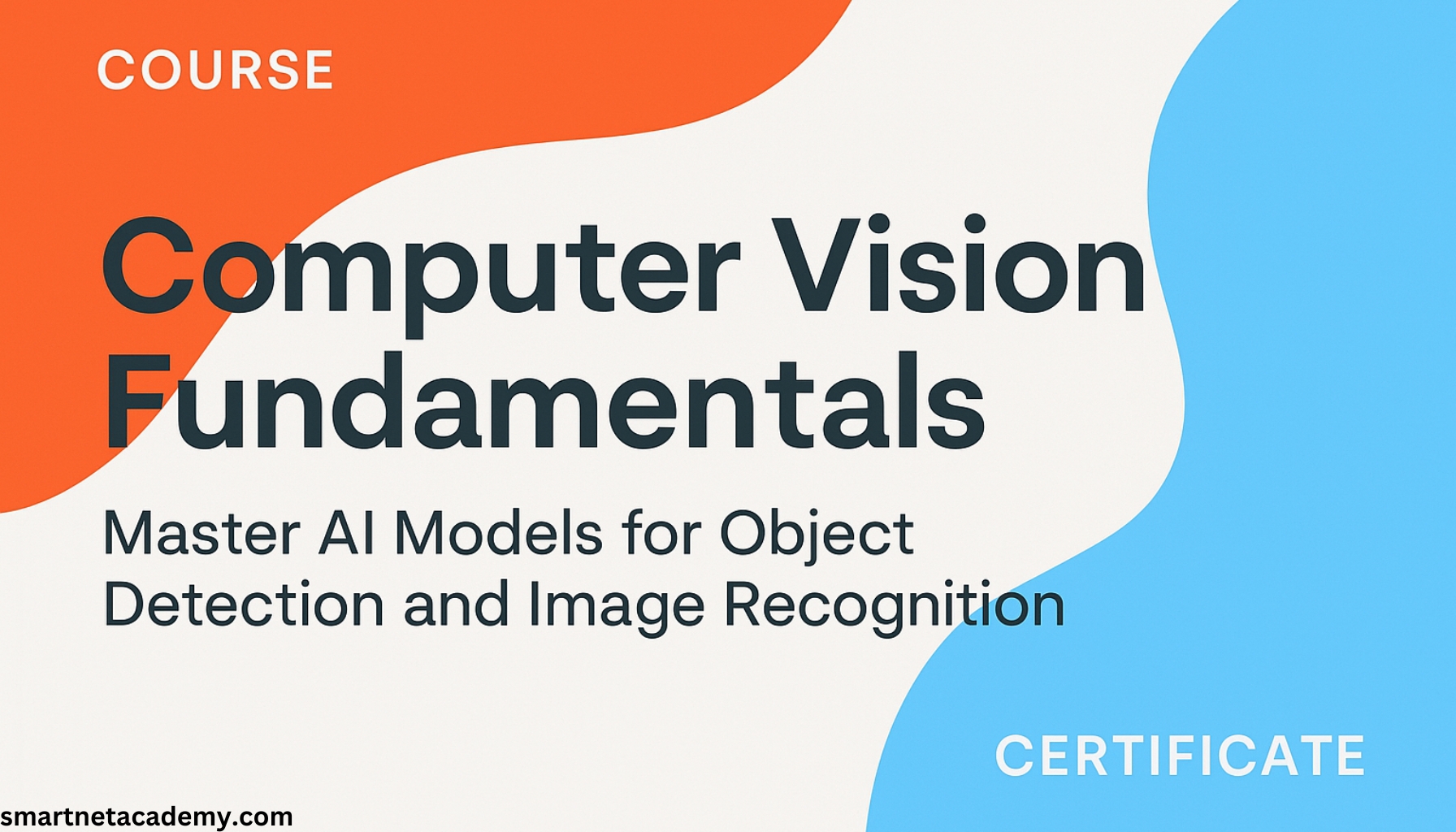
Computer Vision Fundamentals: Master AI Models for Object Detection and Image Recognition
Course Content
Introduction to Computer Vision and Visual Data
-
Understanding Computer Vision: Concepts, History & Applications
00:00 -
Understanding Visual Data Types in Computer Vision
00:00 -
Visual Data Formats Quiz
-
Major Challenges in Computer Vision and Emerging Solutions
00:00
Fundamentals of Image Processing
Feature Detection and Extraction Techniques
Advanced Deep Learning for Image Analysis
Integrating Computer Vision into AI Systems
About Course
Computer vision is one of the most exciting and rapidly evolving fields in artificial intelligence. It enables machines to process and interpret visual data in a way that mimics human vision, allowing them to understand images and videos just like we do. From recognizing faces to detecting objects in real time, computer vision has a vast range of applications across industries. It plays a key role in fields such as healthcare, where AI can analyze medical images for early detection of diseases, and in automotive technology, where self-driving cars rely on computer vision to navigate their environment. Additionally, computer vision is revolutionizing retail through inventory management, enhancing security systems, and improving customer experience. This course offers an in-depth introduction to computer vision, covering everything from basic concepts to advanced machine learning techniques. You will gain both theoretical knowledge and hands-on experience, learning how to build and implement AI models and tools that power visual data analysis.
Upon completion of the course, you will receive a certificate from SmartNet Academy, validating your expertise in the field of computer vision. This certificate is a valuable asset, showcasing your ability to understand and apply computer vision concepts in real-world scenarios. It will enhance your professional credibility and can open doors to exciting career opportunities in AI and machine learning. With the knowledge and practical skills gained, you’ll be able to contribute to the development of AI-powered solutions across various industries, making you a competitive candidate for roles such as computer vision engineer, machine learning engineer, or AI researcher.
What You Will Learn in Computer Vision Fundamentals
Computer Vision Fundamentals: Master AI Models for Object Detection and Image Recognition course is designed to provide you with the skills and knowledge necessary to effectively understand and work with visual data. Whether you’re starting from scratch or aiming to specialize in computer vision, this course will guide you through the core principles, practical applications, and hands-on experience to prepare you for real-world visual data challenges.
Core Principles of Image Processing 📷
In this section, you’ll dive into the fundamental concepts of image processing, the backbone of computer vision. You’ll learn how to handle and manipulate images at a pixel level.
-
Digital Image Representation: Understand how images are represented digitally in pixels.
-
Preprocessing and Enhancement: Learn how to clean, enhance, and normalize images to improve quality for analysis.
-
Image Filtering and Transformation: Apply various filters to sharpen, blur, or detect edges in images.
Mastering Feature Extraction 🔍
Feature extraction is crucial for understanding and identifying key patterns in images. In this section, you will explore how machines can identify important features within an image or video.
-
Edge Detection: Learn techniques to detect edges and boundaries in images.
-
Pattern Recognition: Extract shapes, textures, and key patterns from visual data to enhance analysis.
-
Feature Mapping: Understand how AI models map visual features for further analysis.
Building Object Detection Models 🎯
Object detection is one of the most exciting applications of computer vision. In this section, you will learn to build AI models that can detect and locate objects in images or video streams.
-
Region-based CNNs (R-CNNs): Learn how R-CNNs work to localize and classify objects in images.
-
YOLO (You Only Look Once): Master the real-time object detection technique that divides the image into regions and makes predictions in one pass.
-
Real-Time Detection: Apply these techniques to create systems that can detect and track objects live.
Implementing Image Recognition 🖼️
Once objects are detected, the next step is recognizing and classifying them. This section will introduce you to image recognition using deep learning models like Convolutional Neural Networks (CNNs).
-
CNN Architectures: Learn how CNNs use layers of convolutions to process and analyze visual data.
-
Image Classification: Build models that classify images into categories, from detecting animals to recognizing human faces.
-
Transfer Learning: Learn how to leverage pre-trained models to quickly solve new image recognition tasks.
Deep Learning Techniques for Advanced Computer Vision 🧠
Explore the latest advancements in deep learning and how they’ve revolutionized computer vision. This section will provide you with advanced tools to tackle sophisticated tasks.
-
Advanced CNN Architectures: Dive deeper into specialized CNNs for complex image analysis.
-
Object Tracking: Learn techniques for tracking moving objects across video frames.
-
Segmentation and Face Recognition: Gain insight into segmenting images and implementing facial recognition systems.
Hands-On Labs with Popular Tools ⚙️
You’ll gain practical experience with essential computer vision tools such as OpenCV, TensorFlow, and Keras. These hands-on labs will allow you to apply the knowledge gained in real-world scenarios.
-
OpenCV for Image Processing: Get comfortable with this powerful open-source library for real-time computer vision tasks.
-
TensorFlow & Keras for Deep Learning: Learn how to use these popular frameworks to build, train, and deploy deep learning models for image recognition.
-
End-to-End Projects: Work on end-to-end projects that allow you to implement everything you’ve learned and create a portfolio of computer vision applications.
By the end of this course, you will be equipped with the foundational knowledge and hands-on experience to pursue a career or deepen your skills in computer vision. You’ll understand how AI models process visual data, how to use them for object detection and image recognition, and how to apply them to solve real-world problems. The course will empower you to work on AI-driven visual applications in industries such as healthcare, automotive, retail, and security.
The Power of AI in Visual Data Processing
Artificial Intelligence (AI) has revolutionized the way we approach visual data processing, making what was once thought to be science fiction, a reality. From facial recognition systems to self-driving cars, AI is at the heart of today’s most groundbreaking technologies. By mastering AI models for visual data processing, you will unlock the full potential of computer vision, allowing machines to not only see but understand and make decisions based on visual information. Whether it’s analyzing images, identifying objects, or recognizing faces, AI’s ability to process visual data is transforming numerous industries and applications.
How AI Powers Visual Data Processing 🚀
AI’s ability to process visual data at scale allows machines to mimic human vision, but with much higher precision and speed. This section will introduce you to how AI models work to interpret and analyze images, moving beyond simple visual tasks to complex decision-making processes.
-
Deep Learning and Neural Networks: These AI models are at the forefront of computer vision, learning from vast datasets of images to recognize patterns, classify objects, and predict outcomes. Deep learning algorithms, particularly Convolutional Neural Networks (CNNs), form the backbone of many vision tasks.
-
Real-time Visual Processing: AI models can process visual data in real-time, enabling applications like live video surveillance, facial recognition at airports, and augmented reality in mobile devices. You’ll learn how these models can be implemented for immediate decision-making.
-
Speed and Accuracy: AI models process vast amounts of visual data much faster and with greater accuracy than humans, making them essential for critical applications that require rapid responses, such as autonomous vehicles and healthcare diagnostics.
Key Applications of AI in Visual Data Processing 🌍
AI-driven visual data processing isn’t just a theoretical concept—it’s already being implemented in a variety of fields, bringing tangible benefits in accuracy, efficiency, and cost reduction. In this section, we’ll dive deeper into the key applications of AI in visual data processing.
-
Facial Recognition and Security 🔒: Facial recognition systems powered by AI are used in security systems worldwide, from unlocking devices to identifying criminals in crowds. The course will cover the technology behind these systems and how they function in different environments.
-
Self-Driving Cars 🚗: AI plays a crucial role in enabling autonomous vehicles to interpret their surroundings through real-time image processing. You will learn how AI-driven visual systems analyze road signs, traffic, pedestrians, and more to make driving decisions.
-
Medical Image Analysis 🏥: In healthcare, AI helps radiologists and doctors by analyzing medical images, such as X-rays and MRIs, to detect early signs of disease. By understanding AI’s role in medical image processing, you will gain insights into how these technologies are improving diagnosis accuracy and reducing human error.
-
Retail Automation 🛒: Retailers use AI for inventory management, customer behavior analysis, and checkout automation. Visual data from cameras and sensors is processed by AI systems to track items, predict shopping trends, and enhance the customer experience.
Key Computer Vision Techniques 🧠
To understand how AI achieves its remarkable ability to process visual data, it’s essential to explore the key techniques behind computer vision. This course will cover the following foundational concepts:
-
Image Classification 📸: Learn how AI categorizes images into different classes, such as identifying whether an image is of a dog, cat, or car. You’ll explore various classification models and how they are applied in real-world scenarios like automated quality control in manufacturing.
-
Object Detection 🎯: Master object detection techniques to not only identify objects in images but also pinpoint their exact locations. This technique is used in applications like autonomous driving, security surveillance, and robotic vision.
-
Semantic Segmentation 🧑🔬: Dive into segmentation, which divides an image into meaningful parts, allowing AI to understand the specific components of an image. This technique is critical for applications such as medical imaging for identifying tumor boundaries in scans and agriculture for detecting plant diseases.
Transforming Industries with AI-Driven Visual Data Solutions 🌐
AI’s application in visual data processing is continuously growing, offering innovative solutions to some of the world’s most pressing challenges. As a learner in this course, you will explore how AI technologies are being used to improve efficiencies, reduce costs, and enhance outcomes in multiple industries.
-
Security and Surveillance: Explore how AI models help detect unusual behavior, recognize faces, and enhance public safety.
-
Automated Inspection: AI is used in manufacturing for quality assurance, detecting defects in products and machinery to prevent faults.
-
Retail & Marketing: AI tools are revolutionizing consumer experiences by recognizing purchasing patterns and personalizing shopping experiences.
By the end of the course, you will not only understand the technical side of how these tools work but also how to apply them to solve real-world problems across industries. You’ll gain valuable knowledge and practical skills that can empower you to develop and implement your own AI-driven visual solutions for a range of professional applications.
Tools and Technologies for Computer Vision
To become proficient in computer vision, it is essential to familiarize yourself with the core tools and libraries that are used to build AI models for visual data processing. In this course, you’ll dive deep into popular frameworks and platforms that are crucial for developing computer vision applications. You’ll gain hands-on experience using some of the most powerful tools in the field, enabling you to effectively tackle various image and video processing challenges.
OpenCV: A Comprehensive Library for Image and Video Processing 🖼️🎥
OpenCV (Open Source Computer Vision Library) is one of the most widely used and powerful libraries in computer vision. It provides over 2,500 optimized algorithms for image and video processing, which makes it an ideal choice for both beginners and experts in computer vision.
-
Image Processing: Learn how to use OpenCV to perform operations such as resizing, blurring, and cropping images. This foundational knowledge will be essential as you build more complex models.
-
Object Detection: Explore how to use OpenCV for detecting and tracking objects in real-time video feeds. This is particularly useful in applications like surveillance, robotics, and autonomous vehicles.
-
Face Recognition: OpenCV is widely used for facial recognition applications. In this course, you’ll gain insights into how face detection algorithms work and learn to implement them with OpenCV.
By the end of this section, you’ll be able to process images and videos efficiently, and integrate these skills into your own computer vision projects.
TensorFlow: Building Machine Learning Models for Vision Tasks 🤖
TensorFlow is one of the most popular open-source frameworks for machine learning and deep learning applications. Developed by Google, it supports both research and production applications in AI, particularly in tasks related to image recognition and object detection.
-
Deep Learning Models: Learn how to use TensorFlow to build and train neural networks for image classification, object detection, and semantic segmentation.
-
Convolutional Neural Networks (CNNs): TensorFlow provides an excellent environment to implement CNNs, a key architecture in computer vision tasks. You will learn how to design and optimize these networks for visual data.
-
TensorFlow Lite for Mobile: For those interested in building computer vision applications for mobile devices, this course will introduce TensorFlow Lite, which helps you optimize models for mobile and embedded devices.
Mastering TensorFlow will give you the foundation to build sophisticated AI models that can be used across multiple industries, including healthcare, automotive, and retail.
Keras: Fast Prototyping with Neural Networks ⚙️
Keras is a high-level API for building neural networks on top of lower-level frameworks like TensorFlow. It is designed to allow you to build and train deep learning models quickly and efficiently. Keras is user-friendly, with an intuitive interface, which makes it great for beginners while still being robust enough for experts.
-
Rapid Model Development: Keras allows you to prototype and experiment with neural network architectures at a faster pace. You will learn how to create different layers and optimize the networks for image processing tasks.
-
Model Tuning: Keras makes it easy to fine-tune models by adjusting the number of layers, neurons, and activation functions. In this course, you’ll learn how to optimize your models for higher accuracy.
-
Transfer Learning: Keras simplifies the implementation of transfer learning, allowing you to reuse pre-trained models on new datasets. This is an essential technique in computer vision, especially when working with limited data.
By mastering Keras, you’ll be able to quickly prototype and iterate on computer vision models, bringing your ideas to life with minimal overhead.
PyTorch: Custom Computer Vision Applications with Flexibility 🔧
PyTorch is another deep learning framework that has gained significant traction in recent years due to its flexibility and ease of use. Many researchers and developers prefer PyTorch for its dynamic computational graph, which makes it highly suitable for building custom computer vision applications.
-
Dynamic Computational Graphs: PyTorch’s dynamic nature makes it easier to experiment with models, providing more flexibility for customization and debugging.
-
Custom Computer Vision Models: Learn how to use PyTorch to build specialized models for image classification, object detection, and other computer vision tasks. You’ll be introduced to advanced features such as data augmentation and model optimization.
-
Integration with Other Libraries: PyTorch integrates seamlessly with other tools and libraries, including OpenCV, which enhances its utility for computer vision projects.
By the end of the course, you will have the knowledge to build custom computer vision solutions, using PyTorch’s advanced features to create tailored applications for your specific needs.
Hands-On Experience with Popular Tools and Frameworks ⚙️
Throughout this course, you will gain hands-on experience with OpenCV, TensorFlow, Keras, and PyTorch, equipping you with the necessary tools to implement AI models for real-world computer vision problems. These frameworks are the industry standards for image processing and recognition tasks, and mastering them will set you up for success in computer vision careers.
Understanding Deep Learning in Computer Vision
Deep learning, particularly Convolutional Neural Networks (CNNs), is at the core of most modern computer vision tasks. In this course, we will take a deep dive into CNNs and their applications in visual recognition tasks. You’ll learn how CNNs function, how they are trained, and how to use them to process visual data such as images and videos.
Through detailed case studies and practical examples, you’ll understand how deep learning models can be applied to image classification, object detection, and facial recognition. You’ll also learn about the importance of data preprocessing, augmentation techniques, and fine-tuning models to improve their accuracy.
Real-World Applications of Computer Vision
The skills you will develop throughout this course can be applied across a wide range of industries. Some of the key sectors where computer vision is transforming workflows include:
-
Healthcare: Using computer vision to analyze medical images, such as X-rays and MRIs, to detect diseases and conditions with greater accuracy.
-
Retail: Implementing facial recognition and inventory management systems that streamline operations and enhance the customer experience.
-
Autonomous Vehicles: Developing AI models that enable self-driving cars to recognize objects, navigate safely, and make real-time decisions.
-
Manufacturing and Quality Control: Automating the inspection of products, detecting defects, and improving production line efficiency using computer vision.
By completing this course, you will not only understand how to work with visual data but also how to apply computer vision to these real-world scenarios, unlocking opportunities for innovation in a variety of fields.
Ethical Considerations in Computer Vision
As with any technology, there are ethical considerations when implementing computer vision systems. This course will introduce you to the potential challenges and concerns related to privacy, surveillance, and data bias in computer vision applications. You will learn how to design AI systems that are ethical, transparent, and accountable, ensuring that your work contributes positively to society.
SmartNet Academy is committed to equipping you with the tools to create responsible AI solutions. In this section, you will learn about the ethical principles that should guide your development of AI-powered computer vision applications and how to avoid common pitfalls related to data misuse and algorithmic bias.
Career Prospects and Opportunities in Computer Vision
As AI and computer vision continue to advance, the demand for professionals with expertise in these areas is growing rapidly. Whether you’re looking to work in research and development, build AI applications for a specific industry, or contribute to the growing field of AI-driven automation, this course will provide you with the necessary skills and knowledge to succeed.
Graduates of this course will be equipped to pursue roles such as:
-
Computer Vision Engineer
-
AI Research Scientist
-
Machine Learning Engineer
-
Data Scientist
-
AI Application Developer
The hands-on experience and knowledge you gain will give you a competitive edge in the job market, opening doors to exciting career opportunities in AI and machine learning.
Unlock the Potential of Computer Vision and AI
“Computer Vision Fundamentals: Master AI Models for Object Detection and Image Recognition” is a comprehensive course designed to provide you with the knowledge and hands-on experience needed to excel in the rapidly growing field of computer vision. Whether you’re a beginner or have some prior experience, this course offers a structured, practical approach to learning AI-driven visual data processing.
Offered by SmartNet Academy, this course ensures that you gain both the theoretical foundation and practical skills needed to tackle real-world computer vision challenges. By the end of the course, you will be proficient in building and deploying AI-powered visual recognition systems, making you an invaluable asset to any organization working with visual data.
Enroll now and take the first step towards mastering the transformative field of computer vision!